Top Apush Study Mistakes
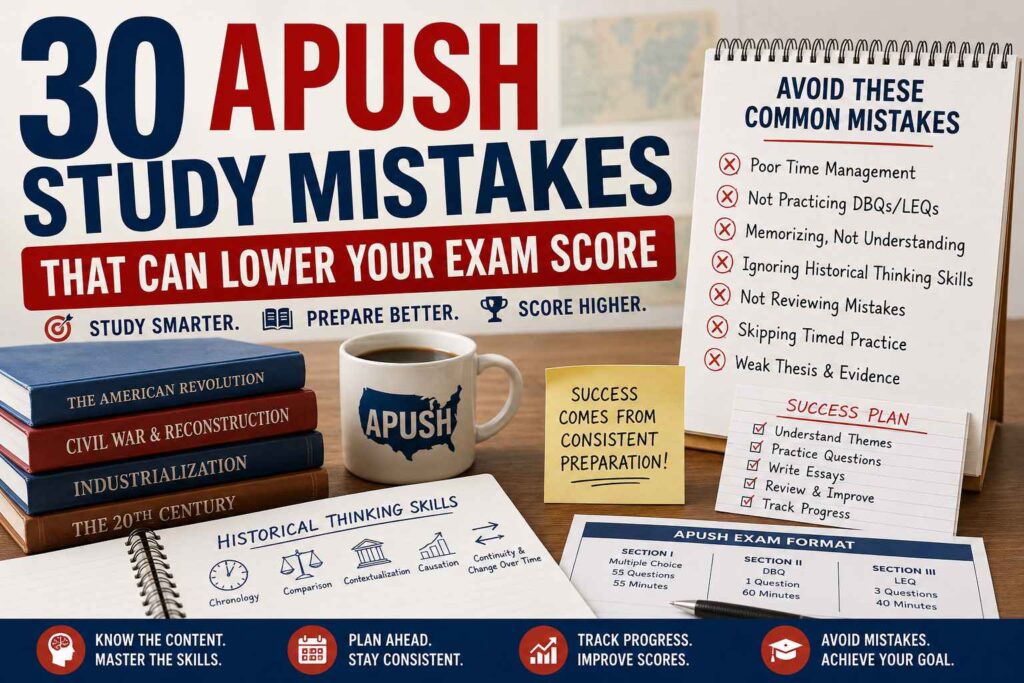
Preparing for the AP U.S. History (APUSH) exam requires more than memorizing dates and historical events. Every year, students lose valuable points because they make common APUSH study mistakes that can easily be avoided with the right strategy.
The APUSH exam tests historical thinking skills, document analysis, argument development, and content knowledge across multiple periods of U.S. history. Students who focus only on memorization often struggle because the exam rewards critical thinking and historical reasoning.
By identifying common APUSH study mistakes early, you can create a more effective study plan and maximize your score potential.
1.Starting Preparation Too Late
One of the biggest mistakes students make is waiting until the final weeks before the exam to begin studying.
APUSH covers hundreds of years of U.S. history. Cramming rarely works because the exam requires deep understanding rather than simple recall.
Better Approach
Create a study schedule several months before the exam and review content consistently.
2. Memorizing Facts Without Understanding Historical Themes
Many students focus entirely on names, dates, and events.
While factual knowledge is important, APUSH emphasizes broader themes such as:
– American Identity
– Politics and Power
– Migration and Settlement
– Culture and Society
– Economic Systems
Understanding how events connect is often more valuable than memorizing isolated facts.
3.Ignoring the APUSH Course Framework
The official course framework outlines exactly what can appear on the exam. Students who rely only on textbooks may spend time studying topics that receive little emphasis while overlooking heavily tested concepts.
4.Neglecting Multiple-Choice Practice
Some students spend all their time writing essays and ignore multiple-choice questions.
Since multiple-choice questions account for a significant portion of the score, regular practice is essential.
Tip
Complete timed practice sets weekly to improve speed and accuracy.
5.Not Practicing DBQs
The Document-Based Question (DBQ) is one of the most challenging sections of the APUSH exam.
Many students read sample DBQs but never write their own responses.
Better Approach
Write multiple DBQs under timed conditions and compare your work to official scoring rubrics.
6.Failing to Analyze Documents
Students often summarize documents instead of analyzing them.
APUSH scorers reward students who evaluate:
– Historical context
– Author perspective
– Intended audience
– Purpose
Document analysis is a critical historical thinking skill.
7. Overlooking LEQ Practice
Long Essay Questions require students to build strong historical arguments.
Without regular practice, students may struggle with organization and evidence selection.
8. Studying Without a Timeline
Historical chronology matters in APUSH.
Students frequently confuse events from different periods because they lack a clear timeline.
Create visual timelines to understand cause-and-effect relationships.
9. Ignoring Historical Context
Many students jump directly into specific events without understanding the larger historical environment.
Strong APUSH responses connect events to broader developments occurring during the same period.
10. Not Reviewing Wrong Answers
Practice tests provide valuable learning opportunities.
Instead of simply checking scores, review every incorrect answer and understand why it was wrong.
11. Relying Only on Videos
Educational videos can be helpful but should not replace active studying.
Successful students combine:
– Reading
– Note-taking
– Practice questions
– Essay writing
12. Taking Notes Passively
Copying textbook pages rarely improves retention.
Active note-taking methods such as summaries, flashcards, and concept maps produce better results.
13. Skipping Reconstruction
Many students focus heavily on the Revolutionary War and Civil War periods while neglecting Reconstruction.
However, Reconstruction remains an important topic that often appears in APUSH questions.
14. Weak Thesis Statements
A weak thesis can hurt both DBQ and LEQ scores.
Your thesis should directly answer the prompt and establish a clear argument.
15. Using Evidence Without Explanation
Listing facts is not enough.
Always explain how evidence supports your argument.
16. Forgetting Historical Thinking Skills
The APUSH exam assesses skills such as:
– Comparison
– Causation
– Continuity and Change Over Time (CCOT)
Practice these skills regularly.
17. Avoiding Timed Practice
Many students understand content but struggle under time pressure.
Timed practice helps build confidence and improve pacing.
18. Studying Every Topic Equally
Not all content areas carry equal importance.
Prioritize major themes and frequently tested periods.
19. Ignoring Rubrics
Official scoring rubrics reveal exactly how points are awarded.
Use them when evaluating your essays.
20. Studying Alone All the Time
Study groups can help clarify confusing topics and expose knowledge gaps.
21. Not Reviewing Previous Units
APUSH is cumulative.
Older content remains relevant throughout the course.
22. Focusing Only on Political History
The exam also covers:
– Economic developments
– Social movements
– Cultural changes
– Foreign policy
23. Overusing Flashcards
Flashcards help with memorization but cannot replace deeper analysis and essay practice.
24. Skipping Practice Exams
Full-length practice exams prepare students for the actual testing experience.
25. Poor Time Management During Essays
Many students spend too much time planning and not enough time writing.
Practice balancing planning and executio
26. Not Learning Common Vocabulary
Terms such as federalism, sectionalism, industrialization, and imperialism appear frequently.
27. Ignoring Teacher Feedback
Feedback often identifies recurring weaknesses that students overlook.
28. Studying Without Clear Goals
Set measurable goals for each study session.
Examples include completing a chapter review or writing a DBQ introduction.
29. Depending on Last-Minute Review Guides
Review guides are helpful supplements but should not replace comprehensive preparation.
30. Forgetting to Monitor Score Progress
Tracking progress helps identify strengths and weaknesses throughout the year.
Using an APUSH score calculator can help estimate performance and determine which sections need improvement.
Final Thoughts
Avoiding these APUSH study mistakes can significantly improve your chances of earning a higher score. The most successful students focus on consistent preparation, active learning, essay practice, and historical reasoning skills rather than relying solely on memorization.