

Calculating your semester grade can be confusing when your course includes multiple grading periods, assignments, tests, and a final exam.
A Semester Grade Calculator helps you combine your grades and their weights to estimate your final semester grade.
For example, your school might calculate a semester grade using two quarters and a final exam. If Quarter 1 is worth 40%, Quarter 2 is worth 40%, and the final exam is worth 20%, each grade contributes a different amount to your final result.
Use our Semester Grade Calculator to calculate your semester grade quickly and see how each grading period affects your overall result.
Important: Schools and teachers can use different grading policies, weighting systems, rounding rules, and grade cutoffs. Always use the weights provided in your syllabus or school grading policy.
What Is a Semester Grade?
A semester grade is the final grade you receive for a course at the end of a semester or academic term.
It is usually calculated by combining grades from different grading periods and assessments according to their assigned weights.
For example, a course might use:
- Quarter 1 grade
- Quarter 2 grade
- Midterm exam
- Final exam
- Projects or other weighted categories
The exact calculation depends on how your school or teacher assigns weights.
Some schools use two quarters plus a final exam, while others use different grading periods or category-based systems.
That is why you should know the weight of each grade before calculating your semester average.
How Does a Semester Grade Calculator Work?
A semester grade calculator uses a weighted average to combine your grades.
The basic formula is:
Semester Grade = (Grade₁ × Weight₁) + (Grade₂ × Weight₂) + (Grade₃ × Weight₃) + …
Weights should normally be entered as decimals when using the formula.
For example:
- 40% = 0.40
- 30% = 0.30
- 20% = 0.20
- 10% = 0.10
If the weights add up to 100%, the calculator can combine the individual grades into one semester grade.
How to Calculate a Semester Grade
Suppose your course uses this grading system:
- Quarter 1 = 40%
- Quarter 2 = 40%
- Final exam = 20%
Your grades are:
- Quarter 1 = 85%
- Quarter 2 = 90%
- Final exam = 80%
The calculation is:
Semester Grade = (85 × 0.40) + (90 × 0.40) + (80 × 0.20)
Calculate each weighted component:
85 × 0.40 = 34
90 × 0.40 = 36
80 × 0.20 = 16
Now add them together:
34 + 36 + 16 = 86
Your estimated semester grade is therefore:
86%
This example shows why you cannot always calculate a semester grade by simply averaging all your grades. Each component may have a different weight.
Common Semester Grade Weighting Systems
There is no single weighting system used by every school.
One common system is:
| Component | Weight |
| Quarter 1 | 40% |
| Quarter 2 | 40% |
| Final Exam | 20% |
Some courses may use a different structure.
For example:
| Component | Weight |
| Quarter 1 | 35% |
| Quarter 2 | 35% |
| Midterm | 10% |
| Final Exam | 20% |
Another course might give the final exam less or more weight.
Because grading policies vary, always check your syllabus, gradebook, or school handbook before entering your weights.
Why Final Exam Weight Matters
The final exam can have a significant effect on your semester grade, especially when it represents a large percentage of the course.
For example, suppose your current grade is 85% and the final exam is worth 20%.
If you earn 95% on the final, your semester grade will increase.
Using the formula:
Semester Grade = (85 × 0.80) + (95 × 0.20)
Semester Grade = 68 + 19
Semester Grade = 87%
Now suppose you earn only 65% on the final:
Semester Grade = (85 × 0.80) + (65 × 0.20)
Semester Grade = 68 + 13
Semester Grade = 81%
The difference demonstrates how the final exam can move your semester grade depending on its weight.
How to Calculate Your Semester Grade From Two Quarters
If your school uses two quarters and a final exam, you can calculate your semester grade by multiplying each grade by its assigned weight.
For a 40/40/20 system:
Semester Grade = (Q1 × 0.40) + (Q2 × 0.40) + (Final × 0.20)
For example:
- Q1 = 88%
- Q2 = 92%
- Final = 85%
Then:
88 × 0.40 = 35.2
92 × 0.40 = 36.8
85 × 0.20 = 17
Add the weighted values:
35.2 + 36.8 + 17 = 89%
Your semester grade would be 89% before applying any school-specific rounding rules.
What Grade Do I Need on the Final to Get a Certain Semester Grade?
A semester grade calculator can also help you determine what score you need on your final exam to reach a target semester grade.
Suppose:
- Quarter 1 = 85%
- Quarter 2 = 90%
- Final exam = 20%
- Target semester grade = 90%
First calculate the points already earned from the two quarters:
85 × 0.40 = 34
90 × 0.40 = 36
Together:
34 + 36 = 70
You need a semester grade of 90%, so you still need:
90 − 70 = 20
Because the final is worth 20%, the required final exam score is:
20 ÷ 0.20 = 100%
Therefore, you would need 100% on the final exam to finish with a 90% semester grade under this weighting system.
This type of calculation can help you set a realistic target before taking your final exam.
Semester Grade vs. Current Grade
Your current grade and semester grade are not always the same thing.
A current grade shows your performance based on the work that has been entered into the gradebook so far.
A semester grade represents the final result after all required grading periods and assessments have been included according to the course’s weighting system.
For example, you might have an 88% current grade before your final exam, but your final semester grade could be higher or lower depending on your final exam score and its weight.
How to Calculate a Semester Grade With Weighted Categories
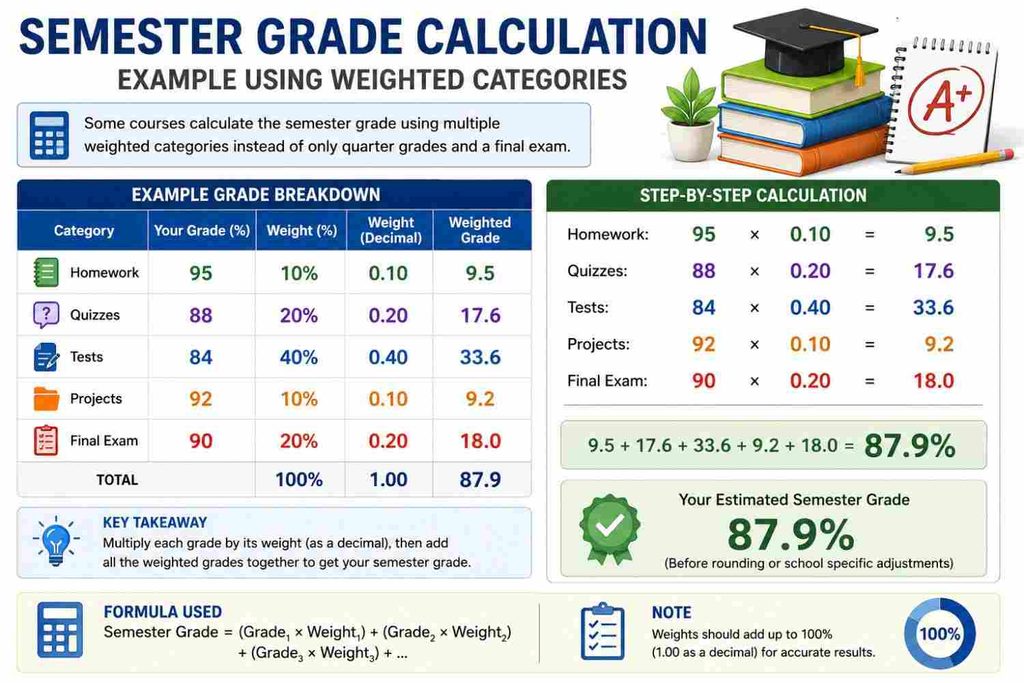
Some courses calculate semester grades using multiple weighted categories instead of only quarter grades and a final exam.
For example, a teacher may use:
- Homework = 10%
- Quizzes = 20%
- Tests = 40%
- Projects = 10%
- Final exam = 20%
Suppose your category grades are:
- Homework = 95%
- Quizzes = 88%
- Tests = 84%
- Projects = 92%
- Final exam = 90%
The calculation would be:
Semester Grade = (95 × 0.10) + (88 × 0.20) + (84 × 0.40) + (92 × 0.10) + (90 × 0.20)
Calculate each category:
95 × 0.10 = 9.5
88 × 0.20 = 17.6
84 × 0.40 = 33.6
92 × 0.10 = 9.2
90 × 0.20 = 18
Now add the weighted values:
9.5 + 17.6 + 33.6 + 9.2 + 18 = 87.9%
Your estimated semester grade would therefore be 87.9%.
This method is useful when your teacher calculates the final grade using weighted grading categories rather than simply averaging individual assignments.
Weighted grading systems calculate category averages and then apply the assigned percentage to each category before combining the results
How to Calculate a Semester Grade Without a Final Exam
Not every course includes a final exam.
If your semester grade is based only on grading periods or categories, you can calculate it using the same weighted-average method.
For example:
- Quarter 1 = 45%
- Quarter 2 = 45%
- Semester project = 10%
Suppose you earned:
- Quarter 1 = 86%
- Quarter 2 = 92%
- Project = 95%
The calculation is:
Semester Grade = (86 × 0.45) + (92 × 0.45) + (95 × 0.10)
Semester Grade = 38.7 + 41.4 + 9.5
Semester Grade = 89.6%
Your semester grade would be approximately 89.6%, before any school-specific rounding.
How Much Can a Final Exam Change Your Semester Grade?
The effect of a final exam depends mainly on its weight.
A final worth 10% will have a smaller effect than a final worth 30%.
For example, suppose your current coursework grade is 85%.
If the final is worth 10%
If you score 95%:
Overall Grade = (85 × 0.90) + (95 × 0.10)
Overall Grade = 86%
If the final is worth 20%
Overall Grade = (85 × 0.80) + (95 × 0.20)
Overall Grade = 87%
If the final is worth 30%
Overall Grade = (85 × 0.70) + (95 × 0.30)
Overall Grade = 88%
The same final exam score can therefore produce different semester grades depending on the exam’s weight.
What Do I Need on My Final to Get an A?
You can calculate the final exam score needed to reach a target semester grade.
Suppose:
- Current coursework grade = 88%
- Final exam weight = 20%
- Target semester grade = 90%
The coursework represents the remaining 80%.
Start with:
90 = (88 × 0.80) + (Final Exam × 0.20)
Calculate the coursework contribution:
88 × 0.80 = 70.4
Now:
90 = 70.4 + (Final Exam × 0.20)
Subtract 70.4:
19.6 = Final Exam × 0.20
Divide by 0.20:
Final Exam = 98%
You would need approximately 98% on the final exam to finish with a 90% semester grade under this example.
What If the Required Final Exam Score Is More Than 100%?
Sometimes the calculation shows that you would need more than 100% on the final exam to reach your target.
For example, your current grade may be too low for the target to be mathematically possible based on the final exam’s weight.
In that situation, the target cannot normally be reached through the final exam alone.
You may need to:
- Improve existing assignments
- Complete available extra credit
- Ask about reassessment opportunities
- Adjust your target
- Focus on maintaining or improving your current grade
A semester grade calculator can help you identify this before spending time preparing for an unrealistic target.
Can a Semester Grade Be Higher Than Your Current Grade?
Yes.
If you perform well on a heavily weighted upcoming assessment, your final semester grade can be higher than your current grade.
For example, if your current coursework average is 82% but your final exam is worth 30% and you score 95%, your semester grade would be:
Semester Grade = (82 × 0.70) + (95 × 0.30)
Semester Grade = 57.4 + 28.5
Semester Grade = 85.9%
Your final semester grade would increase to approximately 85.9%.
The opposite can also happen if your final exam score is significantly lower than your current grade.
Weighted Average vs. Simple Average
One of the most common mistakes when calculating a semester grade is confusing a weighted average with a simple average.
A simple average treats every grade as equally important.
For example, if your grades are:
- 80%
- 90%
- 100%
The simple average is:
(80 + 90 + 100) ÷ 3 = 90%
But if the three grades have different weights, the result can be completely different.
Suppose:
- 80% = 20%
- 90% = 30%
- 100% = 50%
Then:
(80 × 0.20) + (90 × 0.30) + (100 × 0.50)
= 16 + 27 + 50
= 93%
The simple average is 90%, while the weighted average is 93%.
This is why knowing your course’s grading weights is essential.
What Happens If My Grading Weights Do Not Add Up to 100%?
Before calculating your semester grade, check that the weights represent the complete grading system.
For example:
- Quarter 1 = 40%
- Quarter 2 = 40%
- Final exam = 20%
These weights total 100%.
If your weights total less or more than 100%, you may have entered the wrong values or left out a grading category.
Some calculators can normalize weights automatically, but you should still verify the official weighting system used by your teacher or school.
Does Rounding Affect Your Semester Grade?
Rounding rules can vary between schools and teachers.
For example, a calculated grade of 89.6% might be displayed as 90% if the grading policy rounds to the nearest whole number.
Another school may keep the grade as 89.6%.
Some grading systems may also use decimal places, letter-grade cutoffs, or other rules.
Therefore, a calculator’s result should be compared with your school’s official grading policy before determining your final letter grade.
Common Mistakes When Calculating Semester Grades
Using Equal Weights for Every Grade
Do not assume that every quarter, test, or assignment has the same value.
Always check the actual weights.
Forgetting the Final Exam Weight
If your final exam is worth 20%, you cannot simply average your current grade with your final exam score.
The final must be included according to its assigned weight.
Entering Percentages as Whole Numbers
When using the formula manually, remember that 20% is represented as 0.20, not 20.
For example:
90 × 0.20 = 18
Ignoring Your School’s Grading Policy
Different schools can use different formulas.
Your calculator result may differ from the official semester grade if your school’s grading rules include special categories, extra credit, dropped assignments, or other adjustments.
Rounding Too Early
Avoid rounding every intermediate calculation.
Keep the decimal values during the calculation and round the final result according to your school’s policy.
Semester Grade and Letter Grade
After calculating your semester percentage, you may need to convert it into a letter grade.
However, letter-grade cutoffs are not identical at every school.
A common grading scale may look like this:
| Percentage | Letter Grade |
| 90–100% | A |
| 80–89% | B |
| 70–79% | C |
| 60–69% | D |
| Below 60% | F |
This is only an example.
Your school may use different cutoffs, plus/minus grades, or other grading rules.
For example, one school may consider 90% an A, while another may use 93% as the minimum for an A.
Therefore, calculate your semester percentage first and then compare it with your school’s official grading scale.
Semester Grade vs. Semester GPA
A semester grade and semester GPA are related, but they are not the same thing.
Your semester grade is usually the percentage or letter grade you earn in a particular course during a semester.
Your semester GPA is a numerical average that represents your performance across multiple courses during that semester.
For example, you might finish a semester with:
- English = 92%
- Mathematics = 88%
- Biology = 95%
- History = 90%
Each course receives a final grade, which may then be converted into grade points and used to calculate your semester GPA.
The exact GPA conversion depends on your school’s grading system.
Semester Grade vs. Cumulative GPA
Your semester grade represents performance in a specific course or academic term.
Your cumulative GPA represents your overall academic performance across multiple semesters or courses.
For example, you could earn a 90% semester grade in one course while your cumulative GPA reflects grades from several previous semesters.
A strong semester can improve your academic record, but its effect on cumulative GPA depends on factors such as the number of credits and your previous grades.
Can a Final Exam Lower Your Semester Grade?
Yes.
If your final exam score is lower than your current coursework grade, your semester grade may decrease.
For example, suppose your current grade is 90% and your final exam is worth 20%.
If you score 70% on the final:
Semester Grade = (90 × 0.80) + (70 × 0.20)
Semester Grade = 72 + 14
Semester Grade = 86%
Your semester grade would decrease from 90% to approximately 86%.
The amount of change depends on the final exam’s weight.
Can a Final Exam Raise Your Semester Grade?
Yes.
If your final exam score is higher than your current coursework grade, it can increase your semester grade.
Suppose your current grade is 85% and your final exam is worth 20%.
If you score 95%:
Semester Grade = (85 × 0.80) + (95 × 0.20)
Semester Grade = 68 + 19
Semester Grade = 87%
In this example, the final exam raises the semester grade by 2 percentage points.
How Can a Semester Grade Calculator Help Students?
A semester grade calculator can be useful before, during, and after a grading period.
Before a Final Exam
You can calculate the score you need to reach a target semester grade.
During the Semester
You can estimate how your current grades and upcoming assessments may affect your final result.
After a Practice Calculation
You can compare different scenarios and see how changing one grade affects your overall semester grade.
For example, you can calculate what happens if your final exam score is 80%, 90%, or 100%.
This makes it easier to set realistic academic goals.
Frequently Asked Questions About Semester Grades
How do I calculate my semester grade?
Multiply each grade by its assigned weight and add the weighted values together.
The basic formula is:
Semester Grade = (Grade₁ × Weight₁) + (Grade₂ × Weight₂) + …
Make sure the weights add up to 100%.
How do I calculate my semester grade with two quarters?
If each quarter is weighted equally, you can calculate the average of the two quarter grades.
If they have different weights, use a weighted-average formula instead.
For example, with a 40% Quarter 1, 40% Quarter 2, and 20% final exam system:
Semester Grade = (Q1 × 0.40) + (Q2 × 0.40) + (Final × 0.20)
What grade do I need on my final exam?
The required final exam score depends on your current grade, final exam weight, and target semester grade.
You can solve for the final exam score using:
Final Exam Score = (Target Grade − Current Grade × Current Weight) ÷ Final Exam Weight
For example, if your current grade is 88%, the current coursework is worth 80%, and your target is 90%:
Final Exam Score = (90 − 88 × 0.80) ÷ 0.20
Final Exam Score = 98%
Is a semester grade the same as a final grade?
Not always.
A semester grade usually refers to the grade earned during one academic term.
A final course grade may refer to the overall grade for an entire course, which could include multiple semesters or grading periods.
The terminology depends on the school or institution.
Does a final exam always count toward the semester grade?
No.
Some courses include a final exam, while others may use projects, assessments, or other grading categories instead.
Always check your course syllabus or grading policy.
What if my final exam is worth 30%?
You would calculate the remaining coursework as 70%.
For example:
Semester Grade = (Current Grade × 0.70) + (Final Exam × 0.30)
A higher final-exam weight means the exam has a greater impact on your semester result.
Can I use a semester grade calculator for college courses?
Yes, if your college course uses a standard weighted grading system.
However, college courses may have different grading structures, such as points-based systems, category weights, dropped grades, or other rules.
Make sure the calculator matches the grading method used by your instructor.
Why is my calculator result different from my school’s gradebook?
Your school’s gradebook may use rules that are not included in a basic weighted-average calculation.
Possible reasons include:
- Extra credit
- Dropped assignments
- Category weighting
- Missing assignments
- Rounding rules
- Special assessment policies
- Different grading periods
If the results differ, check the official grading policy or ask your teacher how the final grade is calculated.
Final Thoughts
Calculating a semester grade becomes much easier when you know the weight assigned to each part of your course.
A Semester Grade Calculator can help you combine quarter grades, exams, projects, and other weighted categories to estimate your final result.
The most important step is to use the correct grading weights.
You can also use the calculator to determine what score you need on a final exam, compare different grade scenarios, and identify how much an upcoming assessment could affect your semester grade.
Remember that calculator results are estimates when your school’s grading system includes special rules or adjustments.
For the most accurate result, compare your calculation with your course syllabus, gradebook, or official grading policy.